
- Session50 minutes
- Cost$185 flat rate
- WhereNanaimo & area
Where You Might Feel It
A dull ache after sitting for a long time.
- A dull ache after sitting for a long time.
- A sharp twinge going up or down stairs.
- A knee that feels unstable or unreliable.
- Pain that started after a twist, a fall or a sports injury.
- Swelling or puffiness after activity.
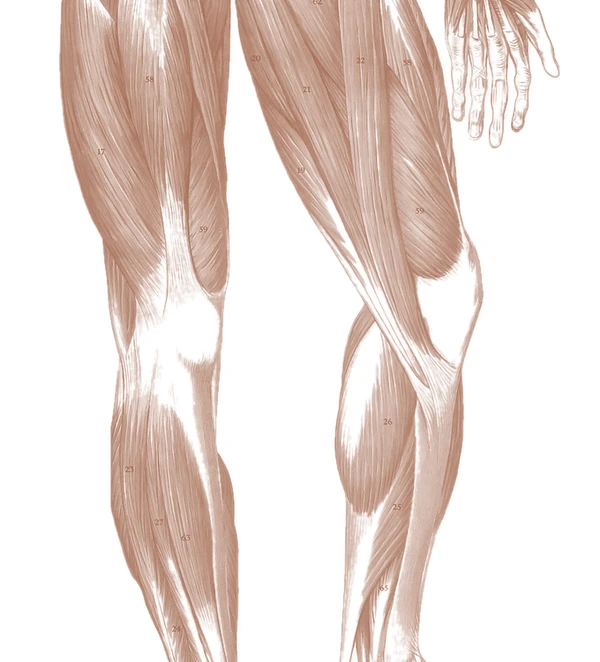
Spots show common areas, not a diagnosis. Illustration adapted from Gustaf Wennman’s anatomical wall chart (c. 1920, public domain): cropped and recoloured.
At a Glance
Common patterns
Twinges on stairs, an ache after sitting, stiffness after activity, or a knee that feels unreliable. It can sit at the front, side or back of the knee.
Look above and below
Your hip and ankle shape how the knee is loaded, so Kayla checks the whole leg and how you walk, squat and step, not just the sore spot.
What's often behind it
Overuse from running or hiking, old injuries, changes in activity and gradual changes over time. Often it is a mix, not one cause.
How Kayla Can Help
Not a fixed protocol. Kayla picks the mix that fits what your knee is doing that day.
Hands-on therapy
Manual techniques and myofascial release around the quads, hamstrings, calves and IT band that may ease tight tissue near the knee.
→Movement assessment
A look at how your hip, knee and ankle work together when you walk, squat and step.
Strength & movement coaching
Targeted exercises that help the muscles around the knee share the load. Strength work is a core part of knee care.
IMS (dry needling)
When a specific tight muscle near the knee is involved, and it fits.
→
Kayla's Whole-Person Approach
Knee pain is not only about the joint. Kayla looks at how your body, your nervous system and your everyday life fit together. This is called a biopsychosocial approach.
Body
How your hip, knee and ankle share the load when you walk, climb stairs or squat. Treatment is matched to what Kayla finds.
Mind
Worry about wear and tear, or fear of moving, can keep people from using a sore knee. Kayla explains what is going on in plain words so you can move with more confidence.
Purpose & vitality
What you want your knee to let you do again, like hiking, running, playing with your kids or taking stairs without thinking about it. Your goals shape the plan.
Setting Expectations
Let's be honest: it depends on what is actually going on in your knee, and that needs an in-person assessment. No website can promise an outcome or a timeline. Kayla will look at the whole leg, explain what she finds in plain words, and build a movement plan. If it looks like you need a scan or a specialist, she will tell you.
BC physiotherapists must explain the benefits and risks of a treatment and get your consent before treating you, and you can stop at any time. See the standards.
Knee Pain: Frequently Asked Questions
Can physiotherapy help knee pain without surgery?
Often it can be part of the answer, and exercise-based physiotherapy is a common first step for many causes of knee pain. It depends on what is going on in your knee, and that needs an in-person assessment. If Kayla thinks you need a scan, a specialist or a doctor, she will tell you.
Should I keep being active if my knee hurts?
Usually some activity is better than none, but the right amount and type depend on the cause. Complete rest can weaken the muscles that support the knee, and pushing through sharp pain is not the answer either. Kayla helps you find a level that is right for now.
Do I need a doctor's referral for knee pain?
No. In BC you can book a physiotherapist directly. A few insurance plans ask for a referral, so it is worth a quick check with yours.
Why does my knee hurt on stairs?
Stairs put a lot of load through the knee, so they often show up first when the joint or the muscles around it are irritated or overloaded. Common reasons include overuse, changes in activity and how the hip and ankle move. Kayla will check what is behind yours.
Can I keep running or hiking with knee pain?
Often you can keep some activity, but it depends on what is behind the pain. Kayla can help you adjust how much, how fast and how often rather than stopping completely, unless she thinks a break is needed.
What happens at a knee pain appointment?
Sessions are 50 minutes. Kayla asks when it hurts and whether there was an injury, then checks the whole leg and how you move. She explains what she finds, treats what fits that day with your consent, and gives you a few specific next steps.