
- Session50 minutes
- Cost$185 flat rate
- WhereNanaimo & area
Where You Might Feel It
Tightness that limits a lift.
- Tightness that limits a lift.
- A nagging ache that only flares under load.
- A sudden injury, like a rolled ankle, a pulled muscle or a hard landing.
- Tendon pain a few kilometres into a run.
- Calf tightness that creeps back when you return to training after time off.
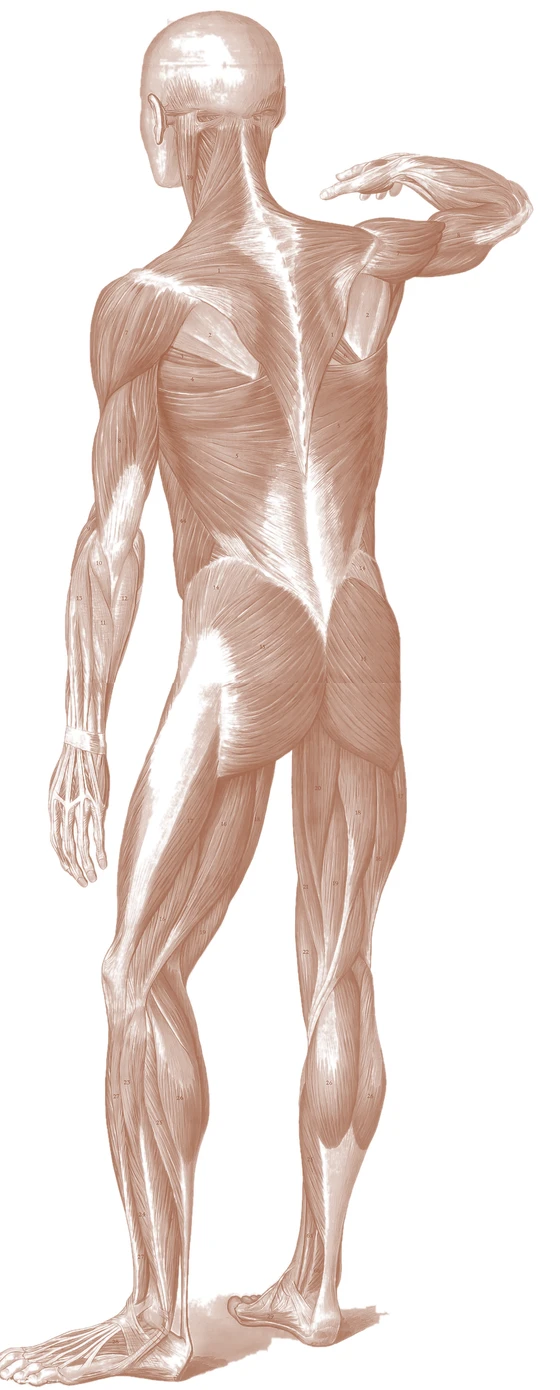
Spots show common areas, not a diagnosis. Illustration adapted from Gustaf Wennman’s anatomical wall chart (c. 1920, public domain): cropped and recoloured.
At a Glance
Common patterns
Some injuries happen in a moment, like a rolled ankle. Others build slowly, like tendon pain after a jump in mileage.
What's often behind it
Changes in training volume or intensity, too little recovery between sessions, form under fatigue, and returning to activity too fast.
Getting back in stages
Rather than all-or-nothing rest, Kayla plans a step-by-step return: settle it down, rebuild strength, then ramp back up to your sport.
Why Kayla gets it

Kayla trains for marathons and triathlons herself. She knows how frustrating a setback can feel when sport is part of your life, and she works with you on getting back to what you love.
How Kayla Can Help
Not a fixed protocol. Kayla picks the mix that fits your injury, your sport and where you are in your season.
Hands-on therapy
Manual techniques and myofascial release that may ease tight or overloaded tissue.
→IMS (dry needling)
For stubborn trigger points in tight muscles, when it fits and you are comfortable with it.
→Movement & strength coaching
Targets the strength gaps and movement habits behind the injury, not just the injury itself.
Return-to-activity pacing
A realistic plan for how, and how much, to keep training while you recover. Kayla trains for marathons and triathlons herself.
Kayla's Whole-Person Approach
A sports injury is not only about the sore tissue. Kayla looks at how your body, your nervous system and your everyday life fit together. This is called a biopsychosocial approach.
Body
The injured area and the movement patterns around it, in the context of your sport and your training load.
Mind
Being sidelined is stressful, and fear of re-injury can hold people back. Kayla explains what is going on in plain words and helps you rebuild confidence in your body.
Purpose & vitality
What your sport gives you, whether it is competing, a weekend ride or a run to clear your head. Your goals set how the plan is paced.
Setting Expectations
Let's be honest: there is no way to promise how quickly you will be back to training. It depends on the injury, how long it has been going on and how your body responds, and that varies a lot between people. Kayla will give you a realistic plan based on what she sees and adjust it as you go. If it looks like you need a scan or a specialist, she will tell you.
BC physiotherapists must explain the benefits and risks of a treatment and get your consent before treating you, and you can stop at any time. See the standards.
Sports Injuries: Frequently Asked Questions
How soon can physiotherapy get me back to training?
There is no honest way to promise a timeline. It depends on the injury, how long you have had it and how your body responds. Kayla gives you a realistic plan based on what she finds and adjusts it as you progress.
Should I stop training completely?
Not necessarily. Complete rest is not always right, and neither is pushing through blindly. Often the aim is to change how much and what kind of training you do while the injury settles. Kayla works out the right level with you once she has assessed it.
Do you treat injuries from a specific sport, or just general fitness?
Both. Kayla sees runners, cyclists, triathletes, team-sport players, lifters and people who are just active. The assessment is built around your sport and its demands, not a generic protocol.
Do I need a doctor's referral for a sports injury?
No. In BC you can book a physiotherapist directly. A few insurance plans ask for a referral, so it is worth a quick check with yours.
What is the difference between a strain and an overuse injury?
A strain happens suddenly, like a pulled muscle in a sprint. An overuse injury builds slowly when the load you put on your body gets ahead of what it has adapted to, like tendon pain after ramping up mileage. Kayla can tell you which she thinks it is after assessing you, and the plan is different for each.
What happens at a sports injury appointment?
Sessions are 50 minutes. Kayla asks what happened or what has been building, and about your training. She checks the injury and how you move, explains what she finds, treats what fits that day with your consent, and gives you a plan for how to keep training.